
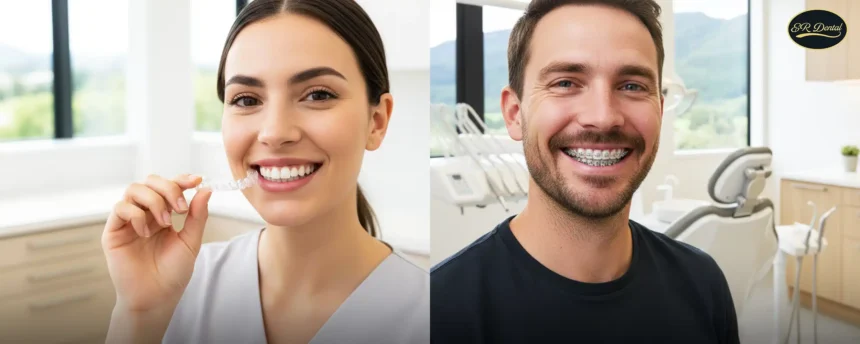
Straightening teeth is the most desired dental treatment nowadays because of clear aligners. The metal braces and brackets are past-day scenarios because of the perks clear aligners bring with them.
However, a dentist should always be the first point of contact to know whether a person needs clear aligners or not.
There are mainly two types of clear aligners that trend, one is doctor-directed aligners, which are prescribed by a dentist, and the other is DIY aligners, if you are opting for at-home aligners.
In this blog, we will discuss the pros and cons of these two types of clear aligners, what is trending, and what social stigmas are revolving around clear aligners.
What Are Clear Aligners?
Clear Aligners are the medical-grade transparent plastic tray which you can wear on your teeth. These trays push your teeth into the desired position to get precisely aligned teeth.
Clear aligners are prescribed if the patient has crooked and misaligned teeth. The alignment issue should be of mild to moderate intensity. The types of misalignments that are treated by clear aligners are:
- Gaps
- Crowding
- Overbite
- Overjet
- Open bite
Characteristics of Clear Aligners:
Clear aligners are easy to maintain and flaunt, but have a bunch of rules that need to be followed to get the desired outcomes, like:
- The clear aligner pair are to be worn as per the chronology the dentist has provided.
- Each set is recommended to be worn for 7-14 days before switching to the next one.
- Patient must regularly wear the aligners for almost 22-24 hours a day.
Why Clear Aligners Are Chosen Over Metal Brackets:
Clear aligners are chosen over metal braces because they are unnoticeable, clear, easy to maintain and pose no food restrictions, other than these:
- Clear aligners are made of PU or PETG material.
- These plastic materials are safe, biocompatible and non-toxic.
- Clear aligners are smooth and comfortable to wear.
- Clear aligners are stain-resistant; thus, they do not turn hazy or yellow.
- Clear aligners are flexible and strong at the same time; thus, they do not get fractured by being in the mouth.
Differentiating the doctor-prescribed and DIY aligners:
| FEATURES | AT-HOME CLEAR ALIGNERS | IN- CLINIC CLEAR ALIGNERS |
| DIRECTED EXECUTION | Do it yourself | Dentist directed treatment |
| COST | 50,000 to 1.5 lacs | 50,000 to 2 lacs |
| DURATION | Around 6 months | 6 – 18 months, as per case needs |
| ADJUSTMENTS | No adjustments possible once treatment starts | Unlimited |
| COMFORT | No dentist visits & no supervision | Limited dentist visits, 360 degrees dentist supervision |
| INDICATIONS | Mild corrections | Mild to severe cases |
| SUCCESS | 50% chances of relapse if not done properly | Almost all cases are successful if proper instructions are followed |
Understanding AT-HOME Clear Aligners:
These are also called DTC, direct-to-consumer aligners that are executed remotely. That means the individuals who want to straighten their teeth can do the process themselves. They must contact a dentist or designated scanning centers for initial impressions.
Process:
- First consultation: After an online consultation, you get your initial DIY IMPRESSION KIT.
- Impressions: Take the impressions yourself or visit a center
- Aligners’ delivery: Your aligners will be delivered to you, and you can start wearing them right away.
- Supervision: Remote consultations are scheduled to see the progress
- Completion: Once the treatment is completed, retainers are prescribed to you.
Advantages:
- Very comfortable: No frequent dentist visits, can be done by yourself. One of the nicest examples of teledentistry
- Affordable: They may quote a little bit less than the dentists.
- Faster: They only correct mild to moderate cases and thus, take less time.
Disadvantages:
- No supervision: There is no dentist to supervise your case closely, so there is no guarantee of the correct execution.
- May be inaccurate: In case someone decides to record the impressions by themselves, that may come out to be completely wrong.
- No customisations: once the treatment is designed, you cannot change it.
- Not suitable for severe cases: these types of clear aligners are suggested for mostly mild cases and are not useful for cases that need supportive or extensive orthodontic treatment.
Understanding Dentist-Directed Clear Aligners:
Dentist-directed clear aligners are known for being reliable and effective. One such brand is Illusion Aligners, which achieves great results with minimal chances of relapse. Let’s look at the process, benefits, and drawbacks of these in-clinic aligners.
Process:
1. Initial Consultation: Your dentist will examine your teeth to assess the alignment. If you choose to proceed, they will present different treatment options.
2. Impressions: The dentist will take moulds of your teeth and will have you return in a few days to pick up your aligners. They may also show you a virtual preview of your new smile.
3. Aligners Delivery: After receiving your aligners, the dentist will explain how to use and care for them.
4. Monitoring: You will have regular appointments to check your progress and make any necessary adjustments.
5. Completion: Once you achieve your desired smile, you will receive retainers to maintain it.
Advantages
- Comfortable
- Customisable
- Faster
- Effective
In a nutshell
Clear aligners are beneficial if you have crooked teeth and do not want to go for metal braces. However, it depends on one’s requirements, case severity, cost factor, and mindset about choosing clear aligners.
Choose in-clinic aligners if:
- You want accurate results
- You are not sure about the treatment and how it happens
- You have moderate to severe misaligned teeth
- You are comfortable visiting the dental clinic once in a while