

What LASIK in Troy really does for your life
Some local ophthalmologists position LASIK eye surgery in Troy and Rochester Hills as a way to change how you move through every ordinary day, rather than just a way to pass a vision chart. When laser reshaping of the cornea reduces or eliminates nearsightedness, farsightedness, or astigmatism, you can wake up and see your alarm clock clearly, work out without worrying about contact lenses, and enjoy outdoor activities without juggling glasses.
Large reviews of LASIK outcomes have found that most patients achieve 20/20 or 20/40 uncorrected vision and report high satisfaction with the impact on daily life. One world literature review reported overall satisfaction rates around 95%, and more recent summaries suggest satisfaction rates above 96% for modern techniques. These data support the idea that LASIK is not just about numbers on a chart. It is about practical freedom from dependence on glasses and contacts for many typical tasks.
A memorable way to say this is that LASIK turns clear vision from something you put on your face into something you carry with you all day.
Meet your LASIK team
Clear Vision Center provides LASIK services through the Clear Vision Cataract and LASIK Center in Rochester Hills, which serves patients from Troy, Rochester, Sterling Heights, Bloomfield Hills, and the wider Metro Detroit region. The practice is physician-owned and operated, and the core LASIK surgeon is Joshua Vrabec, MD. He is a board-certified ophthalmologist, a fellow of the World College of Refractive Surgery and the American Academy of Ophthalmology, and has more than 25 years of experience in medical and surgical eye care.
The practice emphasizes that LASIK consultations are done face-to-face with the actual surgeon rather than a remote call center. During the evaluation, you also meet an on-site LASIK counselor who reviews scheduling and financing so you understand both medical and practical details. The clinic highlights its independently owned status and on-site laser suite, which allows one team to handle screening, surgery, and follow-up under one roof.
In a generalized way, Joshua Vrabec, MD, summarizes this philosophy by saying that at Clear Vision Center, he uses LASIK and other refractive procedures to match each person’s eyes with a plan that feels personal, not like an assembly line.
How LASIK reshapes your cornea for sharper focus
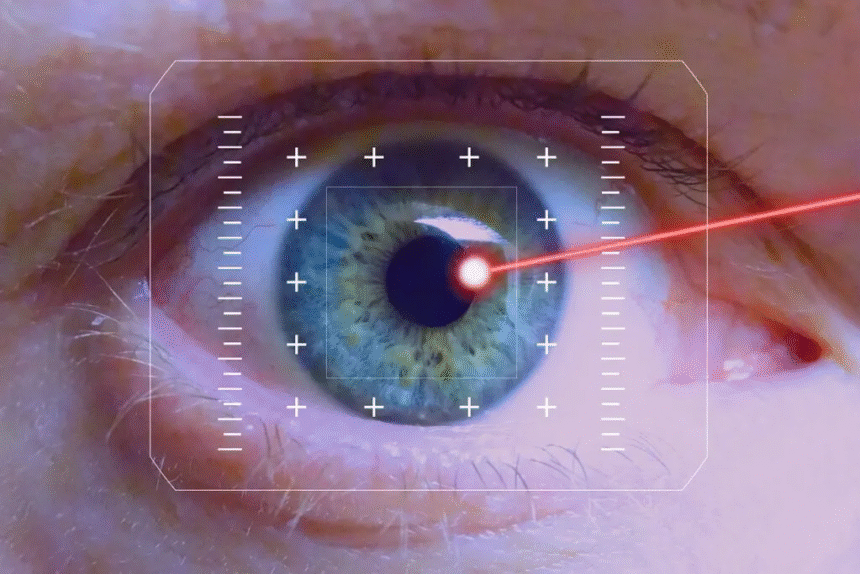
LASIK, or laser-assisted in situ keratomileusis, corrects refractive error by reshaping the cornea so that light focuses more precisely on the retina. After detailed measurements, a femtosecond laser creates a thin flap in the cornea. An excimer laser then removes microscopic layers of tissue according to a planned pattern that depends on your glasses prescription and corneal shape. The flap is repositioned and adheres naturally without stitches.
At Clear Vision Center, LASIK is performed using an all-laser platform that combines the Zeiss Visumax femtosecond laser with the Alcon Wavelight EX500 excimer laser, which is among the fastest FDA-approved excimer systems. Faster treatment means the laser time on the eye is very short, which can improve comfort and reduce the chance of movement affecting results. The Wavelight EX500 platform supports both wavefront optimized LASIK and Contoura topography guided custom LASIK, which allows the surgeon to address both baseline prescription and subtle surface irregularities.
A strong, quotable statement is that LASIK does not add anything to your eye. It refines the shape that is already there so light can land in the right place.
What research actually shows about LASIK safety and results
Modern LASIK is one of the most studied elective procedures in medicine. Reviews of thousands of eyes report that around 99% of patients reach at least 20/40 uncorrected vision, and more than ninety percent reach 20/20. A long-term retrospective study that followed people for about twenty years after surgery found that LASIK remained highly effective and safe, with most patients maintaining good uncorrected vision and relatively rare long-lasting negative effects such as persistent dryness or night vision symptoms.
The FDA’s LASIK Quality of Life Collaboration Project, including the PROWL studies, developed a structured questionnaire to measure symptoms like glare, halos, and dry eye as well as satisfaction after LASIK. These studies showed high satisfaction and that most participants experienced stable or improved visual symptoms rather than major new problems.
Experts also note that serious complications such as flap infection or significant vision loss are rare when modern screening, technology, and experienced surgeons are combined.
A memorable line is that in up-to-date studies, modern LASIK behaves less like an experiment and more like a refined tool whose performance is well-mapped and closely monitored.
Walk through surgery day
On LASIK day, you arrive at the private on-site LASIK suite in Rochester Hills, located within a short drive of Troy and much of Metro Detroit. You can choose to take a low-dose oral sedative, which is why you need a driver. You then relax in a comfortable massaging recliner with light music in a private waiting area.
Before the procedure, your eyes are numbed with drops to prevent pain. The team reviews each step again so you know what to expect. During the procedure, you mainly notice gentle pressure, brief changes in vision, and some sounds from the lasers rather than pain. The active laser treatment time is usually measured in seconds per eye. Most patients spend only fifteen to twenty minutes in the suite.
Afterward, mild irritation, tearing, or light sensitivity are common for a few hours. Many people nap after they go home and notice clearer vision the same evening or the next morning. Studies and clinical experience indicate that most patients return to usual activities within a day or two, although eye rubbing, heavy workouts, and makeup use around the eyes are restricted briefly to protect healing tissue.
In a generalized way, Joshua Vrabec, MD, reassures patients that the goal is to pair advanced all-laser LASIK with a calm, spa-like environment so surgery day feels surprisingly easy instead of intimidating.
How to decide if LASIK eye surgery in Troy, MI, is right for you
Deciding whether LASIK is right for you means looking at eligibility, expectations, and alternative options. Ideal candidates are usually between about 20 and 49 years old, have a stable prescription and healthy corneas, and do not have uncontrolled medical or eye conditions such as untreated keratoconus or active autoimmune eye disease.
Every potential LASIK patient begins with a detailed consultation that reviews prescription, corneal thickness and shape, tear film quality, pupil behavior, and lifestyle needs. If LASIK is not the safest choice, the practice also offers procedures such as PRK, SMILE, EVO ICL, and refractive lens exchange so patients can still pursue vision correction when appropriate.
A key statement worth remembering is that the best LASIK decision is never based on marketing promises. It is based on a careful match between your eyes, your goals, and what evidence says about long-term safety and results for someone like you.
- Is It Time To Finally Have Cataract Surgery? A Practical Guide To Saying Yes
- A Comprehensive Guide to Choosing the Right PMHNP Program for Your Career Goals
- How a clear vision can change your every morning
- Tips for Medication Management in Chronic Conditions
- A Guide to Supportive Surrogacy Environments